Is it better to shout louder, or to have something better to say?
This is the core tension between marketing vs branding. As a founder or business leader in 2025, you are constantly bombarded with conflicting advice. One expert tells you to pour your budget into TikTok ads and SEO (Marketing); another tells you to invest in a robust visual identity and core values (Branding).
If you look at your budget like a procurement spreadsheet, it’s easy to see marketing as the “revenue generator” and branding as a “nice-to-have” cost. But after 12 years in supply chain management before opening PicklesBucket, I view it differently.
Think of it this way: Branding is your inventory. Marketing is your logistics. You can have the best logistics network in the world (Marketing), but if the warehouse is empty or the product is poor (Branding), you are just delivering disappointment faster.
So, where should your limited budget go first? Let’s break down the math.
The Difference: The “Why” vs. The “How”
Before we allocate the pounds, let’s define the terms, because they are often used interchangeably.
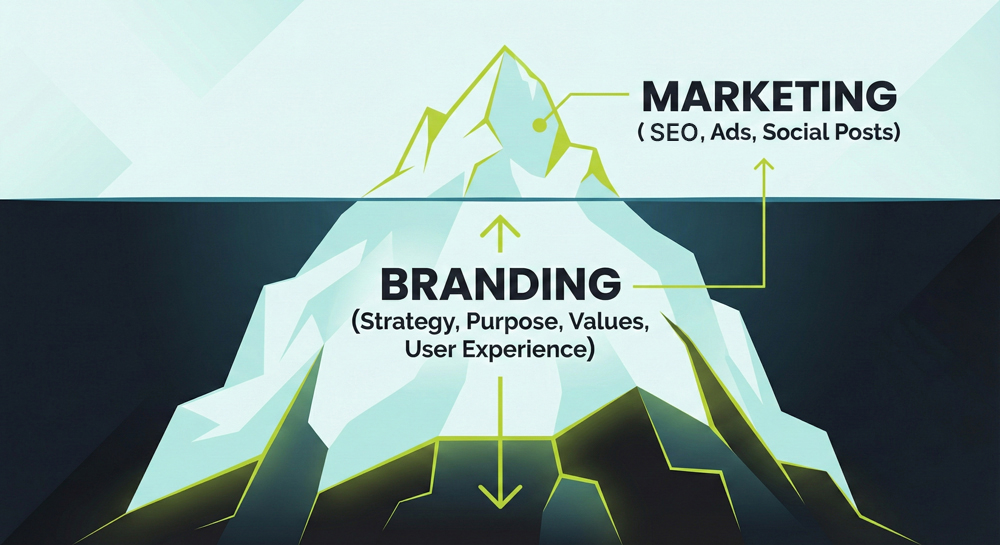
- Branding is who you are. It is your strategy, your visual identity, your tone of voice, and the promise you make to your customers. It is the “pull” factor that builds loyalty and trust.
- Marketing is how you reach people. It is the tactical activation—PPC ads, social media campaigns, email sequences, and sales funnels. It is the “push” factor that drives immediate traffic.
In short: Marketing gets their attention. Branding keeps it.
Phase 1: Why Branding Must Come First (The Foundation)
If you are an early-stage startup or a small business looking to pivot, your first investment must be branding.
Why? Because marketing unbranded products is inefficient. In 2025, the cost of customer acquisition (CAC) is at an all-time high. If you spend £1,000 on ads that drive traffic to a website with a confusing message, a generic logo, or a lack of trust, you might convert 1% of visitors.
If you invest that budget in branding first—clarifying your message and polishing your visuals—that same ad spend might convert at 3% or 4%. Strong branding is a force multiplier for every marketing pound you spend later.
Read More: Why Branding is the Best Investment for Customer Retention
Phase 2: The Budget Split (The 60/40 Rule)
Once your foundation is set, how do you manage the ongoing budget?
For established SMEs, a common mistake is slashing the branding budget to zero once the logo is done. But branding is not a one-time project; it is a reputation management system.
A healthy budget allocation for a growing company in 2025 often looks like this:
- 60% Marketing (Activation): This keeps the cash flow moving. It covers your SEO, paid ads, and content distribution.
- 40% Branding (Brand Building): This covers your content quality, visual assets, customer experience improvements, and long-term brand strategy.
As I discuss in my book, The Modern Brand Strategy Guide, neglecting that 40% leads to “brand drift”—where your company slowly becomes indistinguishable from competitors, forcing you to compete on price alone.
The “Supply Chain” Approach to ROI
Coming from a procurement background, I always look for the “Total Cost of Ownership.”
- Marketing ROI is easy to measure (Clicks, Leads, Sales). It’s quick, addictive, and short-term.
- Branding ROI is harder to measure but more powerful. It lowers your price sensitivity. It increases customer lifetime value (LTV). It turns customers into advocates.
If you skip the branding step, you are essentially paying “expedited shipping” fees on every single sale because you have to work twice as hard to convince a cold audience to trust you.
Your 2025 Action Plan
- Audit Before You Advertise: Before launching your next campaign, look at your website and assets. Do they look like a global player or a local struggle?
- Define Your Core: If you can’t write down your brand’s mission in one sentence, pause your ad spend. (Need help? My Branding Services usually start here).
- Read the Manual: If you want to DIY your strategy before hiring an agency, grab a copy of The Modern Brand Strategy Guide. I wrote it specifically to bridge the gap between abstract strategy and real-world execution.
Ready to stop spending and start investing? At PicklesBucket, we don’t just design pretty things; we build brand infrastructures that make your marketing cheaper and more effective. Let’s chat about your project.